


Intake manifold ?





Diesel Fan
Joined: Jul 2010
Posts: 90
Likes: 0
From: new mexico

i cant seem to get the pic on here but its a pusher its a 3in aluminized. it is arched high enough to take the grid heater out.
Last edited by blackout94; Aug 2, 2010 at 07:43 PM. Reason: Automerged Doublepost
Diesel Fan
Joined: Jan 2009
Posts: 48
Likes: 2
actually, a better flowing intake horn will show a higher boost level @ the manifold, all other variables being constant. This is only noticeable if your boost gauge reference is located in the intake manifold. the reason why is based on decreasing the pressure drop in the plumbing system from the compressor outlet to the head. boost drops with head/cam/turbine housing modifications

I've about $40 into my intake horn, 3" mandrel bends, 1/4" baseplate with grid-heater delete. minimal SOTP gains, but boost gauge read ~1psi increase across the board at any operating point above 3psi (stock turbo)
I've about $40 into my intake horn, 3" mandrel bends, 1/4" baseplate with grid-heater delete. minimal SOTP gains, but boost gauge read ~1psi increase across the board at any operating point above 3psi (stock turbo)

Diesel Wrench
Joined: Feb 2009
Posts: 912
Likes: 60
From: Northeastern, OH
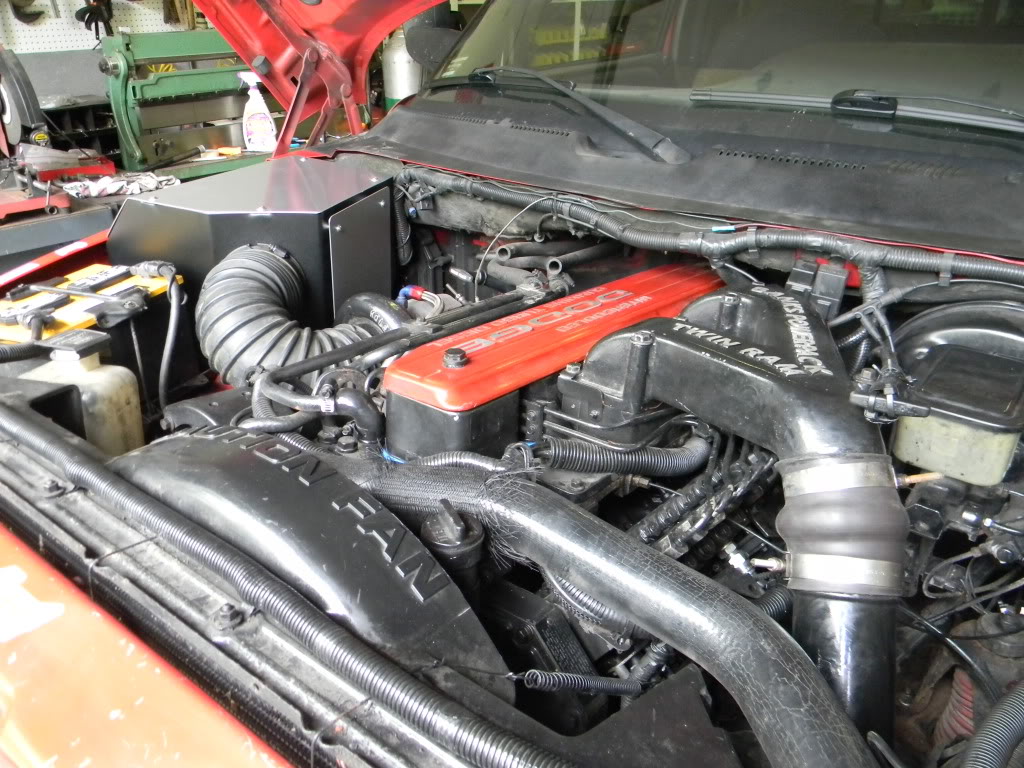
i love my banks.... and yes im the lucky one that did pay 50 bucks for his.... boost is a restriction.... you want lower boost with a better intake.... thats what i have always been told.... this is a new one for me man.... correct me though if im wrong... i want to learn about his now

Diesel Fan
Joined: Jan 2009
Posts: 48
Likes: 2
there is a pressure drop across each item in the plumbing system; if you had a boost reference before and after each component you would be able to see what that drop is.
The highest pressure value would be @ the compressor outlet, then it drops some through the pre-intercooler tube, then more across the intercooler, some again through the post-intercooler tube, some more across the air horn (with/without grid heater), and then into the head. SO, in that situation a boost gauge in the intake 'trough' would show a lower boost value than a gauge in the compressor outlet of the turbo. Therefore, if you introduce a less restrictive component in the intake tract of the engine, the total boost drop would decrease, yielding a higher boost value at the intake 'trough'.
The highest pressure value would be @ the compressor outlet, then it drops some through the pre-intercooler tube, then more across the intercooler, some again through the post-intercooler tube, some more across the air horn (with/without grid heater), and then into the head. SO, in that situation a boost gauge in the intake 'trough' would show a lower boost value than a gauge in the compressor outlet of the turbo. Therefore, if you introduce a less restrictive component in the intake tract of the engine, the total boost drop would decrease, yielding a higher boost value at the intake 'trough'.
Diesel Wrench
Joined: Feb 2009
Posts: 912
Likes: 60
From: Northeastern, OH
ok... well with the banks item its also spiltting the air so that the 5 and 6 gets more too... my egts when down with mine.... but then my gauge port wasnt moved.... i could understand with the single but with the double you are changing how its looked at... right ? or am i completely looking at this wrong....
Diesel Fan
Joined: Jul 2010
Posts: 90
Likes: 0
From: new mexico
if you have the tap in your intake your measuring how much air pressure is built up waiting for the valves to open hurly is right you build the most boost at the turbo and the inercooler and tubing drop it

Thread
Thread Starter
Forum
Replies
Last Post
caissiel
Ford Powerstroke 03-07 6.0L
1
Sep 24, 2015 05:37 PM
jrsavoie
Chevy/GMC 6.2L and 6.5L
1
Feb 6, 2015 09:44 PM


