


Help my truck is about to self destruct


Thread Starter
|
Diesel Enthusiast
Joined: Aug 2008
Posts: 152
Likes: 2
From: Canyon, TX/T-Dad, CO
 Help my truck is about to self destruct
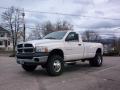
97 4x4 automatic cummins it about to bite the dust. my throttle linkage needs replaced, i have runaways, no rpm's or mph's, all my warning lights are on. The truck refuses to die even after i switch the ignition off and pull the key, i have to shift the automatic maunually, it skips 1st and third gear. the tranny is leaking a little fluid but not a lot just a drip here and there. any suggestions on what's wrong with it. i'm about to check the fuses and make sure everything is good and add more transmission fluid. Since i bought this truck its been nothing but babied around pulling small loads. please help, any advice would be good

BOMBARDIER

Joined: Mar 2007
Posts: 23,293
Likes: 1,322
From: North of You
There is a recall on the throttle linkage: Recall #B15 - Diesel Engine Throttle Linkage
As for not shutting off....pop the hood and pull down on the fuel shutdown solenoid (the linkage on the bottom is what Im talking about). You can remove the solenoid clean it up and it should work again (it may need a new boot). You can get a new boot or a whole new solenoid here:
LarryB's Dodge starting problems solved here.
OR you can do a search here and find out how to install a cable shutdown and it will be fixed for good.
You should scan it with a scanner - you must have some kind of code set (although the 12V doesnt have many codes that can be set).
As for not shutting off....pop the hood and pull down on the fuel shutdown solenoid (the linkage on the bottom is what Im talking about). You can remove the solenoid clean it up and it should work again (it may need a new boot). You can get a new boot or a whole new solenoid here:
LarryB's Dodge starting problems solved here.
OR you can do a search here and find out how to install a cable shutdown and it will be fixed for good.
You should scan it with a scanner - you must have some kind of code set (although the 12V doesnt have many codes that can be set).

Diesel Wrench
Joined: May 2008
Posts: 558
Likes: 25
From: PEI
Sounds like you have your hands full. Your runaway problems make me think pump problems, even if your linkage is broken, the springs on the lever will still make it go to no throttle as opposed to full throttle or "stuck".
Skips 1st and 3rd eh? No idea, valvebody maybe? This is out of my circle and I don't think I'll be of any help haha. Best of luck and post the results when you find them.
Skips 1st and 3rd eh? No idea, valvebody maybe? This is out of my circle and I don't think I'll be of any help haha. Best of luck and post the results when you find them.
Thread Starter
|
Diesel Enthusiast
Joined: Aug 2008
Posts: 152
Likes: 2
From: Canyon, TX/T-Dad, CO
well some of the problems have been solved but i'm still workin on it. first off my fuel solenoid wasn't even mounted so it was just dangling there pinching off the line, so now it shuts off and isn't having runaways, next i drained all the old transmission fluid and then put new fluid in. i am starting to get use out of all my gears again occasionally, but i still have to shift it manually, next i'm about to go outside and check my fuses to see if i can get all my warning lights to shut off and maybe get my speedometer and rpm's back.

Thread Starter
|
Diesel Enthusiast
Joined: Aug 2008
Posts: 152
Likes: 2
From: Canyon, TX/T-Dad, CO
alright thanks, i'll check it out
---AutoMerged DoublePost---
one more question. I know 12 valves are mostly mechanical but does the computer have anything to do with the tranny?
---AutoMerged DoublePost---
one more question. I know 12 valves are mostly mechanical but does the computer have anything to do with the tranny?
Last edited by Rocky Mountain Texan; Jun 17, 2009 at 02:22 PM. Reason: Automerged Doublepost
Diesel Bombers Sponsor

Joined: Mar 2007
Posts: 3,791
Likes: 367
From: Blowing Rock,NC
Your TPS will affect your shift patterns. And yes the trans has a computer!
---AutoMerged DoublePost---
TRANSMISSION CONTROL
The PCM operation includes control of 3 and 4 speed automatic transmissions utilizing electronic governor pressure control, eliminating the need for a separate transmission controller. Transmission control is achieved through regulation of governor pressure using a variable force solenoid valve. (Valve position is controlled by pulse width modulation. Torque convertor lock-up and overdrive solenoids are also controlled by the PCM, as are the transmission protection relay and dashboard overdrive lamp. PCM inputs affecting transmission operation include the throttle position sensor, output shaft speed sensor, vehicle speed sensor, engine speed sensor, brake switch, cruise control switches, ignition, overdrive on/off switch and sump fluid temperature thermistor.
Electronic Governor Pressure Control
Regulation of governor pressure enables control of WOT shift points to within +/- 50 RPM resulting in improved shift quality (as opposed to control to within +/- 300 RPM in transmission utilizing mechanical governors). The elimination of the mechanical governor resulted in a physically smaller and lighter package. Torque calculation can be used to determine when upshifting is advantageous.
Anti-Hunt Shift Strategy
This strategy was added in order to maintain fuel economy over a variety of load conditions. This technique allows for relatively early upshift in mid-range throttle settings under light load conditions, resulting in improved fuel economy. Under heavier loading, shifts are delayed to prevent upshifting into a condition where insufficient torque is available to maintain vehicle speed, resulting in downshift/upshift cycling.
Sump Pump Temperature Sensing
A thermistor is attached to the lock-up solenoid and submerged in the sump fluid. The sump fluid temperature is a factor in the calculation of WOT shift strategy, low temperature shift compensation, sump temperature limiting strategy, overdrive strategy, torque converter clutch strategy, and governor pressure transducer calibration.
---AutoMerged DoublePost---
TRANSMISSION CONTROL
The PCM operation includes control of 3 and 4 speed automatic transmissions utilizing electronic governor pressure control, eliminating the need for a separate transmission controller. Transmission control is achieved through regulation of governor pressure using a variable force solenoid valve. (Valve position is controlled by pulse width modulation. Torque convertor lock-up and overdrive solenoids are also controlled by the PCM, as are the transmission protection relay and dashboard overdrive lamp. PCM inputs affecting transmission operation include the throttle position sensor, output shaft speed sensor, vehicle speed sensor, engine speed sensor, brake switch, cruise control switches, ignition, overdrive on/off switch and sump fluid temperature thermistor.
Electronic Governor Pressure Control
Regulation of governor pressure enables control of WOT shift points to within +/- 50 RPM resulting in improved shift quality (as opposed to control to within +/- 300 RPM in transmission utilizing mechanical governors). The elimination of the mechanical governor resulted in a physically smaller and lighter package. Torque calculation can be used to determine when upshifting is advantageous.
Anti-Hunt Shift Strategy
This strategy was added in order to maintain fuel economy over a variety of load conditions. This technique allows for relatively early upshift in mid-range throttle settings under light load conditions, resulting in improved fuel economy. Under heavier loading, shifts are delayed to prevent upshifting into a condition where insufficient torque is available to maintain vehicle speed, resulting in downshift/upshift cycling.
Sump Pump Temperature Sensing
A thermistor is attached to the lock-up solenoid and submerged in the sump fluid. The sump fluid temperature is a factor in the calculation of WOT shift strategy, low temperature shift compensation, sump temperature limiting strategy, overdrive strategy, torque converter clutch strategy, and governor pressure transducer calibration.
Last edited by mysterync; Jun 17, 2009 at 02:26 PM. Reason: Automerged Doublepost


